Win More Clients: The Anatomy of a High-Impact Business Proposal
You know the feeling. You’ve spent days crafting the perfect pitch, researching the client, and outlining a strategy that will genuinely solve their problem. You hit send on the email, attach the document, and then... you wait. In the competitive world of consulting, freelancing, and agency work, the difference between a signed contract and a polite rejection often isn't just the content of your offer—it’s the presentation. A messy, disorganized, or amateurish proposal can undermine even the most brilliant strategy. It suggests a lack of professionalism and attention to detail before you’ve even had a chance to prove yourself. That’s where a robust Business Proposal Template becomes more than just a document; it becomes your silent partner, ensuring your ideas are communicated with the clarity and authority they deserve.
Visual Communication: The First Impression
Before a single word of your proposal is read, the visual layout communicates volumes. A well-structured document with clear hierarchy, ample white space, and consistent branding subconsciously tells the reader that you are organized, reliable, and serious. Conversely, a cluttered page with mismatched fonts and erratic spacing creates cognitive load, making your key points harder to absorb. The goal is to make the review process effortless for your potential client. This is why design isn’t just about aesthetics; it’s about functionality. A premium template is engineered with this principle at its core, using industry-standard design techniques to guide the reader’s eye naturally from the problem statement to your proposed solution and, finally, to the call to action.
Beyond Aesthetics: The Technical Foundation of a Polished Proposal
True professionalism is in the details you might not consciously notice but absolutely feel. This is where the technical specifications of a high-quality template come into play. Consider the difference between a standard digital file and a print-ready document. A template designed with a 300dpi resolution and CMYK color mode isn’t just for sending as a PDF—it’s prepared for any scenario. Whether your client prefers a digital review or wants to print it for a team meeting, your proposal will look crisp, professional, and color-accurate. Features like fully editable, layered files in Adobe InDesign give you complete control. Need to adjust a section to better fit a client’s specific brand guidelines? With layered templates, you can modify colors, swap images, and restructure layouts without breaking the design’s integrity. The inclusion of bleed margins (like the standard 0.25” bleed) ensures that any printed version has clean, edge-to-edge color, eliminating the amateur look of a white border.
Practical Applications: From Pitch to Signed Contract
The versatility of a well-designed proposal template extends far beyond a simple service quote. It’s a foundational asset for a range of professional communications. For branding and design agencies, it serves as the perfect vessel for presenting a logo design or brand identity system, allowing you to showcase mockups and mood boards in a cohesive narrative. Marketing professionals can use it to outline complex campaign strategies, integrating social media graphics and content calendars into a single, persuasive document. For product-based businesses, it becomes a packaging design or wholesale partnership proposal, where the visual presentation of the template itself echoes the quality of the product inside.
Think about the needs of a small business owner pitching to a local retailer, a creative entrepreneur applying for a grant, or a freelance writer bidding on a large editorial project. In each case, the proposal is a direct reflection of their brand. Using a template that supports Google Fonts and free fonts means you can maintain typographic consistency with your website and other marketing materials without incurring extra costs. This consistency is key to building brand recognition. When your proposal uses the same serif font for headings and sans serif font for body copy as your business cards and web design, you present a unified, memorable identity.
Maximizing Impact with Smart Design Choices
A template provides the structure, but your content and customization bring it to life. Here’s how to leverage its features for maximum impact:
- Typography that Talks: The included font pairing suggestions are a starting point. A display font for your main title can grab attention, while a highly legible modern typography style for the body ensures your detailed plans are easy to read. Always prioritize readability over ornate style for long-form text.
- Color Psychology: The template’s easy color customization allows you to do more than just match your brand palette. Use color strategically to highlight key metrics, differentiate sections, or evoke specific emotions aligned with your client’s industry. The CMYK-ready setup ensures these colors translate perfectly from screen to print.
- Content Flow and Hierarchy: Use the layered structure to your advantage. The 18-page overall layout provides ample space. Don’t fill every page. Use headings, subheadings, and bullet points (like this list) to break up text and create a visual roadmap. This improves audience engagement by preventing information overload.
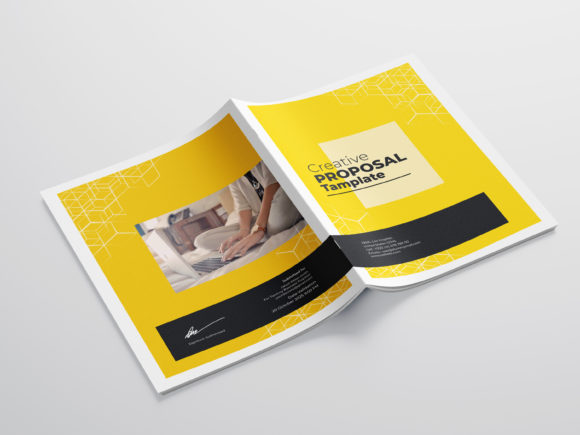
- The Power of Mockups: While the provided JPEG previews and mock-up files are for illustration, they serve a crucial purpose. They show you how to present your own work. Instead of just describing a website redesign, place a screenshot of your proposed design into a laptop mockup within the template. This visual demonstration is far more persuasive than words alone.
Remember, the mockups and photos used in previews are not included—they are there to inspire how you might integrate your own project visuals. Your unique content is what transforms the template from a generic shell into a compelling, client-specific argument.
Streamlining Your Workflow for Consistent Results
For any professional who regularly submits proposals, efficiency is critical. Starting from a blank page each time is not only time-consuming but also increases the risk of inconsistency and error. A comprehensive template package, complete with indd, indml, indt, and pdf file formats, along with a help file, is designed to integrate seamlessly into your workflow. You create a master proposal once, tailored to your brand, and then duplicate and customize it for each new opportunity. This ensures that every proposal you send out has the same high-quality foundation, reinforcing your professional image with every submission. It allows you to focus your energy on the unique value proposition for each client, rather than on formatting headaches.
In the end, winning business is about trust. You are asking a client to invest their time, money, and confidence in you. A meticulously prepared business proposal, built on a solid and professional template, is one of the most effective tools you have to earn that trust from the very first glance. It communicates that you respect their time, you value quality, and you are fully prepared to deliver on your promises.